A clever article here about steampunk, and the reasons it appeals to people. Lots of good quotes; this was probably my favorite:
A lot of kids in today’s steampunk music & style scene used to identify with the goth aesthetic — and are pleasantly surprised to discover that normal adults seem intrigued by this new thing rather than alarmed. Well, yeah. People think of goths as weirdoes who take vampires too seriously, and therefore they can’t help being worried on some level that a crazy goth might, you know, want to make them bleed. Whereas steampunks are — what? Weirdoes who take pocket-watches too seriously? What are they gonna do, vehemently tell you what time it is?
Sigh. That makes me all nostalgiac for playing a mad scientist.
Sunday, September 21, 2008

Sunday, September 14, 2008
Politics and Moral Reasoning
This is interesting.
It's a series of polls/studies that you can take to evaluate your own moral decision-making process. Not the moral choices themselves, that is, so much as the grounds by which we make choices.
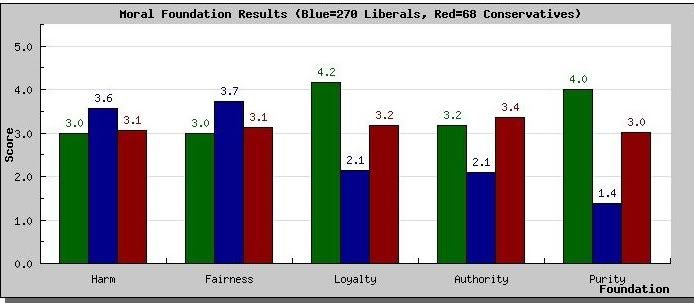
The first one, the "Moral Foundations Questionnaire," divides moral reasoning into five categories: Harm, Fairness, Loyalty, Authority, and Purity. It ranks your interest in each of these categories, and then generates a chart comparing it with the averages for liberals and conservatives.
I find this kind of thing compelling, because so many political conversations seem to involve people talking past each other. They're not connecting in some way; and I think a lot of our mutual frustration comes from that.
(Well, aside from the frustration that comes from not getting everything we want, of course. Which is also a big part of politics.)
Anyway. The differences are really striking. My entries are in green, conservatives' are in red, and liberals are blue. (Tsk, that's unreadable! Click on it to get a more legible chart.)

It's a series of polls/studies that you can take to evaluate your own moral decision-making process. Not the moral choices themselves, that is, so much as the grounds by which we make choices.
The first one, the "Moral Foundations Questionnaire," divides moral reasoning into five categories: Harm, Fairness, Loyalty, Authority, and Purity. It ranks your interest in each of these categories, and then generates a chart comparing it with the averages for liberals and conservatives.
I find this kind of thing compelling, because so many political conversations seem to involve people talking past each other. They're not connecting in some way; and I think a lot of our mutual frustration comes from that.
(Well, aside from the frustration that comes from not getting everything we want, of course. Which is also a big part of politics.)
Anyway. The differences are really striking. My entries are in green, conservatives' are in red, and liberals are blue. (Tsk, that's unreadable! Click on it to get a more legible chart.)
Tuesday, August 5, 2008
What, No Laser Eye Powers?
Update on Real Life #1: I've just had Lasik surgery done to my left eye. I was hoping that a malfunction in the equipment might leave me with special visual superpowers, but no such luck. Tsk!
I've been nearsighted, particularly in my left eye, since my early teenage years. I never had the money to deal with it until now; to be fair, it wasn't that big a problem. I wasn't blind without my glasses, and I'd much rather be nearsighted than farsighted: needing glasses to read would be a pain.
(Unfortunately, reading glasses are probably in my future. One reason that the doctor didn't want to Lasik my right eye is that almost everyone becomes farsighted in their 40s, and my nearsightedness would defer that for a few years. Which is kind of cool, when you think about it.)
The surgery was uncomfortable, in the sense that you had to stay perfectly still and unblinking; but it was totally painless, for which I am grateful. Now I just have to keep up with the eyedrops, and get used to the fact that I'm not wearing glasses anymore.
(More of an adjustment than I expected- I feel like my face is naked.)
I've been nearsighted, particularly in my left eye, since my early teenage years. I never had the money to deal with it until now; to be fair, it wasn't that big a problem. I wasn't blind without my glasses, and I'd much rather be nearsighted than farsighted: needing glasses to read would be a pain.
(Unfortunately, reading glasses are probably in my future. One reason that the doctor didn't want to Lasik my right eye is that almost everyone becomes farsighted in their 40s, and my nearsightedness would defer that for a few years. Which is kind of cool, when you think about it.)
The surgery was uncomfortable, in the sense that you had to stay perfectly still and unblinking; but it was totally painless, for which I am grateful. Now I just have to keep up with the eyedrops, and get used to the fact that I'm not wearing glasses anymore.
(More of an adjustment than I expected- I feel like my face is naked.)
Well, It's Been A While...
My whole "Post By Email During Deployment" scheme didn't quite work out as planned. It turns out that blogging by email is oddly disspiriting; it's just like sending out emails to someone who never replies.
(Not that I get a lot of replies, granted; but I can see the output, and that's very helpful. On board the ship, it just felt like throwing emails into the void.)
So I'm back. And now, hopefully, I'll have things to say!
(Not that I get a lot of replies, granted; but I can see the output, and that's very helpful. On board the ship, it just felt like throwing emails into the void.)
So I'm back. And now, hopefully, I'll have things to say!
Wednesday, April 2, 2008
Code of the Speechmaker
James P. Hogan's Code of the Lifemaker starts off very nicely. An ancient alien survey ship, designed to set up automated factories on uninhabited planets, ends up damaged on the moon Titan. There, the imperfect automatons undergo their own kind of evolutionary process, ending up with something very like organic life.
(This prologue is the best part of the novel, and it's excerpted here.)
The rest of the novel deals with a human expedition to Titan, which over the ages since the prologue has evolved its own machine ecosystems and even sentient machine life. The robots are at a roughly medieval/Renaessance level of development, and the humans take great advantage of this as they prepare to make Titan into an economic colony.
The writing is solid. The characters, with one exception, are shallow but tolerable. Hogan works hard to make his bizarre mechanical-organic world plausible, and it kind of works.
There are two problems. The first is that Hogan puts speeches into various characters' mouths- mostly, in this novel, about the advantages of the scientific method. This gets old quickly.
The second problem is something I've noted about Heinlein: the assumption that politics is chess writ large, a completely rational and controllable game that smart people can arrange to their liking. This is implausible enough with humans, especially with religion added in; with an unknown alien race, the idea breaks down completely.
I suppose I was expecting a very different ending to the humans' various machinations and deceptions. But on Titan, you really can fool all the people all the time.
(This prologue is the best part of the novel, and it's excerpted here.)
The rest of the novel deals with a human expedition to Titan, which over the ages since the prologue has evolved its own machine ecosystems and even sentient machine life. The robots are at a roughly medieval/Renaessance level of development, and the humans take great advantage of this as they prepare to make Titan into an economic colony.
The writing is solid. The characters, with one exception, are shallow but tolerable. Hogan works hard to make his bizarre mechanical-organic world plausible, and it kind of works.
There are two problems. The first is that Hogan puts speeches into various characters' mouths- mostly, in this novel, about the advantages of the scientific method. This gets old quickly.
The second problem is something I've noted about Heinlein: the assumption that politics is chess writ large, a completely rational and controllable game that smart people can arrange to their liking. This is implausible enough with humans, especially with religion added in; with an unknown alien race, the idea breaks down completely.
I suppose I was expecting a very different ending to the humans' various machinations and deceptions. But on Titan, you really can fool all the people all the time.
38 And Counting...
It's my birthday today!
37 was a good year; 38 is beginning to feel the chill shadow of looming 40. But there's two long years to get ready for that.
It's been a good day. I just wish there was cake to be had!
37 was a good year; 38 is beginning to feel the chill shadow of looming 40. But there's two long years to get ready for that.
It's been a good day. I just wish there was cake to be had!
Subscribe to:
Posts (Atom)