Well, not exactly. I'm off the ship, but still formally stationed in Norfolk until the 10th. The ship left this morning, off to adventure and excitement on the high seas, while I slept late.
There's an odd feeling of disconnection. It's not just that I've left the people I've worked with for four years (though that's certainly part of it.) But I've had obligations of all kinds over the past few years, and none of them apply to me now. It's low-stress, I suppose, but also isolated and rather boring: I feel like I'm spinning my wheels.
Oh, well. Soon to Florida! (With a stopoff at my parents' to see my dog and my bouncy, train-loving nephew.) And soon I'll be muttering about the complications of radio tech manuals.
Saturday, February 7, 2009

Wednesday, February 4, 2009
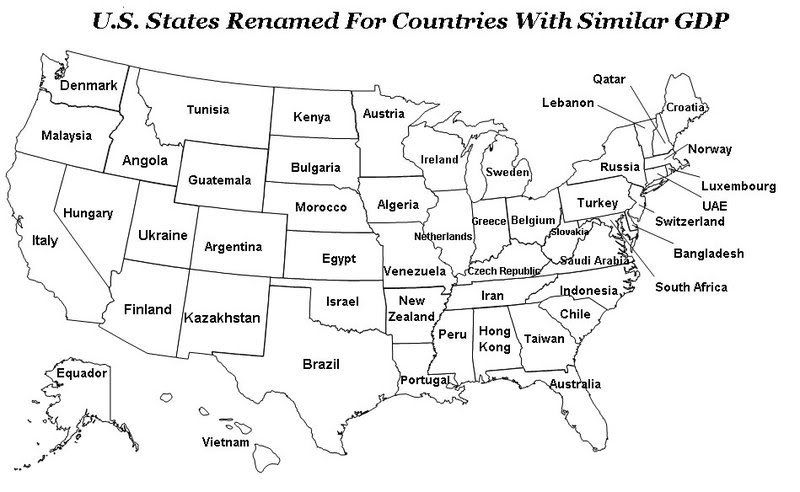
We Are The World (Or Its GDP)
Another weird map, which unfortunately is too large and lengthwise to be shown here. (But click and see!)
So, basically, the names of the states have been replaced by the names of countries with a roughly-similar Gross Domestic Product. Which gives us the bizarre view of an America made up of an entirely-different kind of states.
It's fun to look at, but it doesn't really tell us much as a map, for a couple of reasons. The most prominent states (aside from the one you live in, I guess) are going to be the geographically-largest ones; and California and Texas excepted, size doesn't equate to economic strength. Notice how the tiny northeastern states are crowded with developed-world nations, but the large-scale west has nations like Bulgaria.
Secondly, but closely-related: geographic size doesn't tell us anything about population, and population is much more of an economic indicator than landmass.
But, still. It's fun and interesting to gawk at; if only because the replacements give me geeky parallel-earth imaginings.
(Are there any other kind?)
So, basically, the names of the states have been replaced by the names of countries with a roughly-similar Gross Domestic Product. Which gives us the bizarre view of an America made up of an entirely-different kind of states.
It's fun to look at, but it doesn't really tell us much as a map, for a couple of reasons. The most prominent states (aside from the one you live in, I guess) are going to be the geographically-largest ones; and California and Texas excepted, size doesn't equate to economic strength. Notice how the tiny northeastern states are crowded with developed-world nations, but the large-scale west has nations like Bulgaria.
Secondly, but closely-related: geographic size doesn't tell us anything about population, and population is much more of an economic indicator than landmass.
But, still. It's fun and interesting to gawk at; if only because the replacements give me geeky parallel-earth imaginings.
(Are there any other kind?)
The Future, Systematically Presented
A Comprehensive Map of All Possible Human Futures.
Yikes! But it does have a sort of rough-hewn, Darwinian get-right-to-the-point kind of plausibility about it.
Yikes! But it does have a sort of rough-hewn, Darwinian get-right-to-the-point kind of plausibility about it.
Whoops, New Year!
I haven't exactly been hibernating (ah, that would have been nice...) It's just been extremely busy as I prepare my move to sunny Florida.
But hopefully I'll be posting again, now that I'm home. I've got a couple of things saved up that I'd meant to blog about.
But hopefully I'll be posting again, now that I'm home. I've got a couple of things saved up that I'd meant to blog about.
Wednesday, November 26, 2008
Friday, November 14, 2008
HR8799?
From cnn.com:
Astronomers capture first images of new planets
The first-ever pictures of planets outside our solar system were released today in two studies.
Using the latest techniques in space technology, astronomers at NASA and the Lawrence Livermore National Laboratory used direct-imaging techniques to capture pictures of four newly discovered planets orbiting stars outside our solar system.
"After all these years, it's amazing to have a picture showing not one but three planets," said physicist Bruce Macintosh of the Lawrence Livermore National Laboratory in Livermore, California.
"The discovery of the HR 8799 system is a crucial step on the road to the ultimate detection of another Earth," he said.
None of the planets is remotely habitable, scientists said.
Both sets of research findings were published Thursday in Science Express, a journal of the American Association for the Advancement of Science.
A team of American and British astronomers and physicists, using the Gemini North and Keck telescopes on the Mauna Kea mountaintop in Hawaii, observed host star HR8799 to find three of the new planets.
Scientists estimate that HR8799, roughly 1.5 times the size of the sun, is 130 light years from Earth in the constellation of Pegasus. The individual planets in this planetary family are estimated to be seven to 10 times the mass of Jupiter.
Astronomers say the star is too faint to detect with the human eye, but observers could probably see it through binoculars or small telescopes.
"This discovery is the first time we have directly imaged a family of planets around a normal star outside of our solar system," said Christian Marois, the lead astronomer in the Lawrence Livermore lab study.
It continues to amaze me that we can detect extrasolar planets now. Granted, they're humongous superjovian planets, but still. Planets! It gives me a continuing geeky thrill.
I just wish we had a better name for the star- or, rather, any real name at all. HR8799? That isn't a star, that's a bill before Congress.
Astronomers capture first images of new planets
The first-ever pictures of planets outside our solar system were released today in two studies.
Using the latest techniques in space technology, astronomers at NASA and the Lawrence Livermore National Laboratory used direct-imaging techniques to capture pictures of four newly discovered planets orbiting stars outside our solar system.
"After all these years, it's amazing to have a picture showing not one but three planets," said physicist Bruce Macintosh of the Lawrence Livermore National Laboratory in Livermore, California.
"The discovery of the HR 8799 system is a crucial step on the road to the ultimate detection of another Earth," he said.
None of the planets is remotely habitable, scientists said.
Both sets of research findings were published Thursday in Science Express, a journal of the American Association for the Advancement of Science.
A team of American and British astronomers and physicists, using the Gemini North and Keck telescopes on the Mauna Kea mountaintop in Hawaii, observed host star HR8799 to find three of the new planets.
Scientists estimate that HR8799, roughly 1.5 times the size of the sun, is 130 light years from Earth in the constellation of Pegasus. The individual planets in this planetary family are estimated to be seven to 10 times the mass of Jupiter.
Astronomers say the star is too faint to detect with the human eye, but observers could probably see it through binoculars or small telescopes.
"This discovery is the first time we have directly imaged a family of planets around a normal star outside of our solar system," said Christian Marois, the lead astronomer in the Lawrence Livermore lab study.
It continues to amaze me that we can detect extrasolar planets now. Granted, they're humongous superjovian planets, but still. Planets! It gives me a continuing geeky thrill.
I just wish we had a better name for the star- or, rather, any real name at all. HR8799? That isn't a star, that's a bill before Congress.
Tuesday, November 11, 2008
Mundanity in Science Fiction
Courtesy of Bruce Sterling's blog, we have Geoff Ryman's Mundane SF Manifesto:
- That interstellar travel remains unlikely; that Warp drives, worm holes, and other forms of faster-than-light travel are wish fulfillment fantasies rather than serious speculation about a possible future.
- That unfounded speculation about interstellar travel can lead to an illusion of a universe abundant with worlds as hospitable to life as this Earth. This is also viewed as unlikely.
- That this dream of abundance can encourage a wasteful attitude to the abundance that is here on Earth.
- That there is no evidence whatsoever of intelligences elsewhere in the universe.
- That absence of evidence is not evidence of absence -- however, it is considered unlikely that alien intelligences will overcome the physical constraints on interstellar travel any better than we can.
- That interstellar trade (and colonization, war, federations, etc.) is therefore highly unlikely.
- That communication with alien intelligences over such vast distances will be vexed by: the enormous time lag in exchange of messages and the likelihood of enormous and probably currently unimaginable differences between us and aliens.
- That there is no present evidence whatsoever that quantum uncertainty has any effect at the macro level and that therefore it is highly unlikely that there are whole alternative universes to be visited.
- That therefore our most likely future is on this planet and within this solar system, and that it is highly unlikely that intelligent life survives elsewhere in this solar system. Any contact with aliens is likely to be tenuous, and unprofitable.
- That the most likely future is one in which we only have ourselves and this planet.
I have mixed feelings.
First of all, I rather like it when artists- whether writers, painters, filmmakers or whatever- develop a code that guides their work. When such codes are designed intelligently, they can lend useful structure and a kind of context to art.
But I love me some space opera. Star Trek, Star Wars, Iain M. Banks, you name it. I know that the first two are goofy science fantasy, and the latter tries to compensate for the lost wonder of space by going for Really Big Effects; but still, I love it. It's the closest thing to a real sense-of-wonder effect that I'm likely to see in SF.
The tone doesn't help much either- it's basically a concession that sf is escapism, but that they will be different. They will be serious, responsible, and relevant. They will address serious causes, not just in their explicit writing, but in the subtle psychological effects of their writing.
I'm not sure that this can possibly work. But i have to give them credit for trying.
- That interstellar travel remains unlikely; that Warp drives, worm holes, and other forms of faster-than-light travel are wish fulfillment fantasies rather than serious speculation about a possible future.
- That unfounded speculation about interstellar travel can lead to an illusion of a universe abundant with worlds as hospitable to life as this Earth. This is also viewed as unlikely.
- That this dream of abundance can encourage a wasteful attitude to the abundance that is here on Earth.
- That there is no evidence whatsoever of intelligences elsewhere in the universe.
- That absence of evidence is not evidence of absence -- however, it is considered unlikely that alien intelligences will overcome the physical constraints on interstellar travel any better than we can.
- That interstellar trade (and colonization, war, federations, etc.) is therefore highly unlikely.
- That communication with alien intelligences over such vast distances will be vexed by: the enormous time lag in exchange of messages and the likelihood of enormous and probably currently unimaginable differences between us and aliens.
- That there is no present evidence whatsoever that quantum uncertainty has any effect at the macro level and that therefore it is highly unlikely that there are whole alternative universes to be visited.
- That therefore our most likely future is on this planet and within this solar system, and that it is highly unlikely that intelligent life survives elsewhere in this solar system. Any contact with aliens is likely to be tenuous, and unprofitable.
- That the most likely future is one in which we only have ourselves and this planet.
I have mixed feelings.
First of all, I rather like it when artists- whether writers, painters, filmmakers or whatever- develop a code that guides their work. When such codes are designed intelligently, they can lend useful structure and a kind of context to art.
But I love me some space opera. Star Trek, Star Wars, Iain M. Banks, you name it. I know that the first two are goofy science fantasy, and the latter tries to compensate for the lost wonder of space by going for Really Big Effects; but still, I love it. It's the closest thing to a real sense-of-wonder effect that I'm likely to see in SF.
The tone doesn't help much either- it's basically a concession that sf is escapism, but that they will be different. They will be serious, responsible, and relevant. They will address serious causes, not just in their explicit writing, but in the subtle psychological effects of their writing.
I'm not sure that this can possibly work. But i have to give them credit for trying.
Subscribe to:
Posts (Atom)